// hunnaG / games

Games

They run in your browser. All of them are free.

Released

Ready to play. Most still get updates.

Blob Siege

A shooter in your browser where everything is made of blocks you can build with or blow apart. Defend a fort against another team, hold off endless zombie waves and their giant bosses together, or race up a ladder of guns. Send a friend a link to join, or fill the empty seats with bots. Free, on a PC, with nothing to install and no account needed.

PCup to 12 online · bots fill seatsupdated

Blob Siege is a first-person shooter where the whole world is made of blocks. Walls, towers and whole forts go up in seconds, and anything built can be shot or blown apart, so no two games play out the same. It runs in a browser tab on a PC: open the page, send a friend the link, and you are playing together. There is nothing to install and no account to make.

Three ways to play

Capture the Zone. Two teams, five a side to start with. Defenders build a fort around a flag; attackers choose where to strike from and try to take it.

Zombie Survival. Everyone together against waves of zombies that never stop growing. Build walls, buy guns from the Mystery Box and upgrade them, and stock up from a supply helicopter between waves. The zombies climb, dig and tear your walls apart, and giant bosses join in as the waves go on: a Zombie Bear, a Zombie T-Rex and an undead dragon.

Gun game. Everyone for themselves. Every kill hands you the next gun on a ladder, and the first to get a kill with the knife at the top wins.

Friends, bots and leaderboards

  • Host a game and share its link or its five-letter code. Up to twelve players fit in one game.
  • Nobody around? Bots fill the empty seats, from Very easy to Very hard, and play every mode the way a person would. A friend who joins later takes a bot’s seat.
  • Paint your own blob, pick a map (a castle, a beach, a military base, the backrooms and more), and change the game rules to suit you.
  • Leaderboards for every mode, with player profiles and badges. You start as a guest; save an account with a name and password, Discord or Google, and your blob and settings follow you to any browser.

Under the hood

Built with TypeScript and three.js. Games are peer-to-peer: the host’s browser runs the match and the other players connect straight to it (WebRTC, through PeerJS), so there is no game server in the middle. Some school, work and mobile networks block direct connections, and a relay server carries the game for players on those.

Smugglers N Sheriffs

A bluffing party game you play on your phones. Each round one player is the Sheriff and everyone else smuggles: they secretly pack crates of goods and contraband and try to get them through with a straight face or a bribe, while the Sheriff decides whose crate to search. Nothing to install, and bots can fill the empty seats.

phone · PC3–8 online · bots fill seatsupdated

Smugglers N Sheriffs is a party game about lying to your friends’ faces. It is quick to learn and at its best with a group that likes to bluff, bargain and accuse each other. Everyone plays on the phone already in their pocket: one person makes a room, and the others join with its four-letter code or an invite link.

How a round goes

Pack. Everyone shops from the same market: three legal goods and three kinds of contraband. Contraband pays more, but bigger pieces cover more of your three-by-three crate, so they are easier to find. Pack in secret, and put a bribe on the table if you like.

Inspect. The Sheriff has a few action points to search crates and shake smugglers down, and every result is announced to the whole table. Bribes can be offered, changed or pulled at any moment, and a smuggler can tip the Sheriff off about a rival.

Sell. Every crate opens, and whatever got past the Sheriff sells. The Sheriff’s star moves on until everyone has worn it, and the richest player wins.

Good to know

  • Made for phones; a computer’s browser works too.
  • Short on players? The host can fill empty seats with bots, each a character with its own greed.
  • No app and no account: open the page and play.

Under the hood

Built with TypeScript and React. Each room runs on Cloudflare as a Durable Object, one small server per game, which keeps every phone in the room in step.

  • Made for phones: everyone joins the same room on their own phone. A PC browser works too.
  • Make a room and share its four-letter code or the invite link. Bots can fill the empty seats.

Monopalade

A business game about running a lemonade stand for a month. Buy lemons, set your price and open up; weather, picky customers and surprises on the street decide how the day goes. At night you restock, advertise, and decide whether to borrow from a bank that watches your credit score. Made for a phone, and fine on a computer too.

phone · PCsoloupdated

Monopalade is a relaxed business game about running a lemonade stand for a month. The days are short, so it fits a spare moment on a phone. It began in 2019 as a hackathon game about money skills, and it still teaches a few without lecturing: buying in bulk against letting stock go to waste, pricing for the crowd, and what borrowing does to a credit score.

You start with $25, a credit score of 650 and no lemons. Finish day thirty with a top-level stand and $2,400 for the Lemonade Empire ending; smaller fortunes get lesser endings, and running out of money with bad credit means bankruptcy. After day thirty you can keep going.

How a day goes

At night, plan. Buy lemons in three qualities. Bulk packs are cheaper per cup, but lemons go stale after a couple of nights. Set your price, upgrade the stand, and pick advertising, from flyers to a TV feature.

By day, sell. Open the stand and watch the street. Every passer-by has a budget and a taste for quality: they buy when the price is right, and happy customers spread the word. The weather decides how many people come out, and the forecast is usually right.

Surprises. From the second week the street has its own ideas: a festival that doubles the crowd, road works that thin it, a school trip, a rival stand undercutting you, and a health inspector who fines stale lemons.

The credit score

The bank lends according to your score: nothing under 580, small and expensive loans in the 600s, bigger and cheaper ones above 700. Repayments come out every night. Paying on time raises the score, missing a payment lowers it, and running out of cash forces an emergency loan at a painful rate. Borrow early to grow fast, or play it safe.

Also in it

  • A daily challenge: the same season for everyone, with a board of the best results.
  • A season review with charts of your money, customers and lemons, and medals for what the run did well.
  • Speed the day up to 4x, or skip straight to the results.

Under the hood

The 2019 original was built in Unity by a team of three, and its customers were hand-drawn by a friend at the event. The web version keeps that design and rebuilds the rest in TypeScript. The economy is a deterministic, tested simulation: the same starting seed always plays out the same way, which is how the daily board checks every run by replaying it. The street is drawn live on a canvas and changes with the weather and the time of day.

Unlucky Traveler

A survival adventure drawn entirely in letters and symbols. You've been bitten, and you have sixteen days to find the one healer who can cure you: buy rumours in towns, climb towers to spot her smoke, and fight, dodge or run from whatever lives out there. Every run is a new world. Plays in the browser with keys or taps.

phone · PCsoloupdated

Unlucky Traveler is a short, tense adventure in the style of old computer games, where the whole world is drawn with text characters. Something bit you on the way in. A healer far out can cure it, nobody is sure where, and you have sixteen days of walking before the poison wins. Each run builds a new world, and when you die you start again: the kind of game people call a roguelike.

What you do

Explore. The map is a hundred squares by a hundred, with two roads crossing at the centre, where every run begins. The roads are safe; the wild is not. The farther you go, the worse what lives there and the better what is left lying about. Every ? is a place: a town, a bandit camp, a cave or a landmark.

Hunt for the healer. Buy rumours in towns, listen to what people say, and climb a water tower, radio mast or lighthouse to look for her smoke. Cure the bite and the clock stops; then keep walking for a higher score.

Stop in towns. Trade, upgrade your weapon, search the place, chat, or pay for a bed. Or attack the town and fight its protector, and it will hate you for good.

Fight. Attack, dodge or flee. Heal from your bag, and turn experience into levels. The creatures come from the original game: the Rabid Squirrel, the Uncanny Bear, the Cannibalistic Clown and more.

Two versions

Pick one from the menu. Version 1 is the game as it was written. Version 2, the Burn, is harder: the land dries out into ground where nothing grows, every step out there costs health unless you carry water, and the healer waits behind a walled gate.

Where it came from

It began in July 2020 as a C++ game played by typing commands: one file, never finished. This version brings it to the browser in TypeScript, keeps its world and its writing, and finishes what it left. The game’s rules are kept apart from the screen and tested, and every world comes from a seed, so a run can be replayed exactly.

Elements

hunnaG did not design Elements. Zanzarino Design made it, as a Flash card game first released in 2009, and it went offline along with Flash. This unofficial recreation brings it back as close to the original as it can: build a deck from twelve elements, duel computer opponents up to the False Gods, or duel another player online.

PCsolo · 1v1 onlineupdated

Not hunnaG’s design. Elements was created by Zanzarino Design. It was a Flash collectible card game, first released in 2009 and built up over the years after, and it went offline along with Flash. Every rule, card and screen in it is theirs. This is an unofficial fan recreation, made so the game can be played again, and it is not connected to the original’s makers.

What kind of game it is. Two players with 100 health each take turns playing cards. Every card belongs to one of twelve elements, such as fire, water, life and death, and is paid for with quanta, the energy your pillars make each turn. Creatures attack, spells strike or protect, and weapons and shields change the fight. Choosing which elements go in your deck is the heart of the game.

What is in it. Build a deck and duel the computer, from the Trainer up to the False Gods at the end of the quests. Win electrum, the game’s money, to buy and upgrade cards, or duel another player online. Progress is kept with an account on the game’s own server.

Faithful on purpose. When the original and convenience disagree, the original wins. The rules follow the original card set, the computer opponents play the decks they played, and the screens are rebuilt from screenshots of the Flash game. The card art is redrawn after the original’s.

Under the hood. Plain JavaScript in the browser. Accounts, saves and online duels run on Cloudflare: Workers, a D1 database and Durable Objects.

Credits. Elements and its design belong to Zanzarino Design. The card data comes from the openEtG project, under its MIT license.

  • A desktop browser, with a mouse.
  • Progress is kept with an account on the game's own server: a name and a password, and an e-mail only if you want one.

In development

Playable while they are being made. Expect changes.

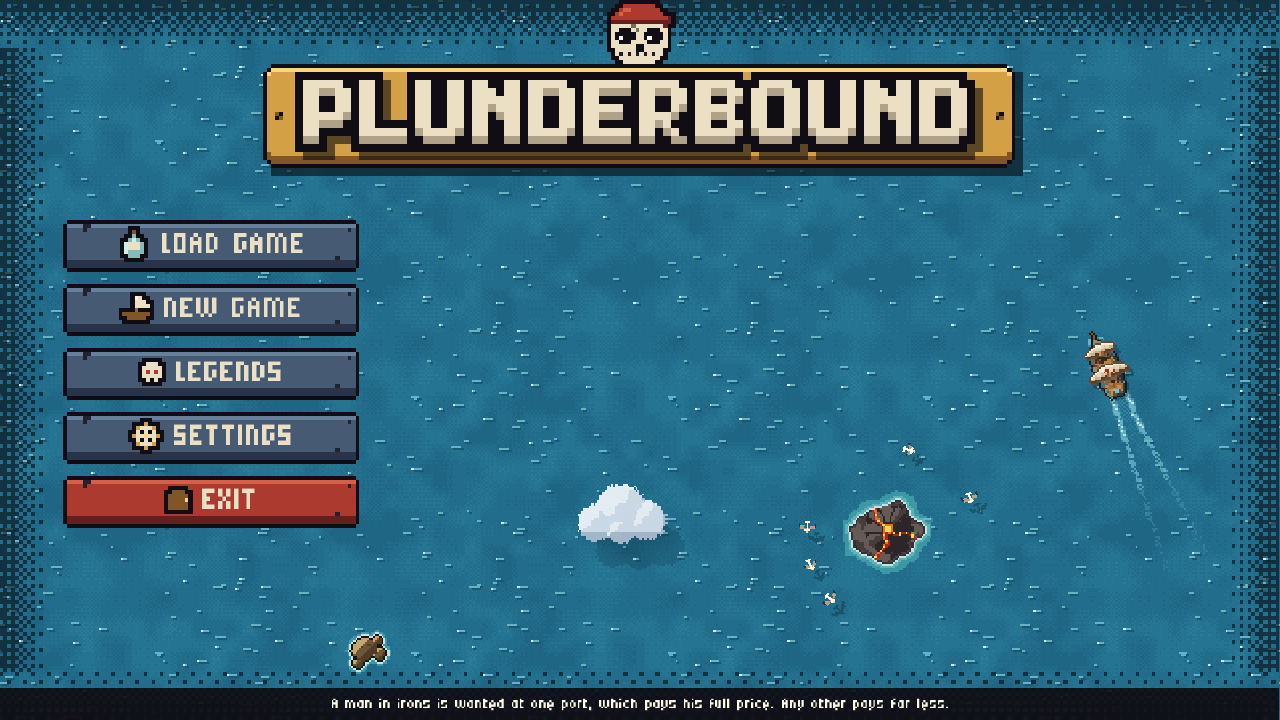
Plunderbound

A pixel-art pirate adventure, still being made. Take a ship and a crew onto a dangerous sea: fight ship to ship, board and fight on deck, explore islands and ports, and keep your crew fed, healthy and loyal, or face a mutiny. Your name, cruel or merciful, decides whether the next ship surrenders or runs. An early version plays in a desktop browser; a download is coming soon.

PCsoloupdated

Plunderbound is a pirate game seen from above, in pixel art. You captain a crew, not a lone hero, across a sea that gets more dangerous the farther you sail, and the story is the name you make out there. It is still being made: an early version plays in a desktop browser now, and a downloadable release is coming soon.

Your name. Two things follow you around: how widely you are known, and what you are known for, from cruel to merciful. Word only spreads when somebody lives to tell it, so sinking a ship with every hand aboard earns you almost no name at all. A feared name makes ships surrender at a hail; a name for keeping your word makes them surrender knowing they will live. A cruel one brings out the bounty hunters.

At sea. Sailing and ship fights happen in real time: round, chain and grape shot, wind that comes and goes, and an iron ram. Board an enemy and the fight moves to the deck, turn by turn.

Your crew. Fifty-one unique crewmates to find, each with a story and words of their own. They make friends and grudges, learn new moves as they level up, and need food, care for their wounds and good morale. Run the ship badly and they grumble, then mutiny.

Ashore and beyond. Explore islands and wrecks, trade each region’s goods in port, fit out your ship at the shipwright, storm forts, and hunt the Crown’s treasure ship. Old stories lead across six regions, from the Known Waters to the Maw.

Starts and ends. Choose how your company starts. No Quarter gives you one life and no second chances. The Legends remember what every finished voyage left behind.

Under the hood. Made in Ruby with DragonRuby, a small game engine. The browser version saves in that browser, on that device. Bugs can be reported from inside the game, and players can choose to share anonymous numbers about their voyages to help with balance.

Screens

Plunderbound screenshot
  • A desktop browser, with a mouse and keyboard.
  • The first visit downloads about 36 MB. Then click to begin; the sound starts then.
  • Saves are kept in that browser, on that device.
  • A downloadable release is coming soon. The browser version is an early look at a bigger game.

// keys

Keyboard

jd
next entry
ka
previous entry
enterspace
open or close the focused entry
esc
close the focused entry, or this panel
/
find a project, a command, or a page
?
this panel

    ↑ ↓ to move · enter to open · esc to close